
2026 CUE Fellowship Showcase: Reimagining Our Future

On Thursday, May 14, 2026, the Chicago Art Department served as the location for an evening full of innovation and inspiration with our vibrant CUEmmunity at our Annual Fellowship Showcase.
In celebration of the culmination of the year-long Racial Equity Fellowship, the 2025 Fellows presented their Racial Equity Projects to a room of 135 CUE supporters and partners, igniting change and celebrating their commitment to racial equity.
The evening's program began with captivating, emotional live music and spoken-word performances by Sam Thousand and Orion Meadows, 2025 Fellows.
Left to Right: Sam Thousand and Orion Meadows.
Tamela Meehan, CUE Board Co-Chair and 2019 CUE Fellow, welcomed our guests and opened up the program with heartfelt words of appreciation for being among CUE supporters, past, present, and future Fellows.
Rachel Pate, CUE’s Director of Civic Programming, shared a ‘CUE In Review’ of the last year, sharing updates on our work within our Co-Governance initiative and our Racial Equity Fellowship. Dr. Emilia Chico, CUE’s Fellowship Consultant, who has led the 2025 Fellowship cohort through their workshops and reflections, presented the 2025 Fellows, and those presenting their projects.
Left to Right: Tamela Meehan, CUE Board Co-Chair, Rachel Pate, CUE Director of Programming, and Emilia Chico, CUE Fellowship Consultant.
2025 Fellows' Projects
The projects presented were examples of the diversity of the 2025 Fellows’ Racial Equity Projects, highlighting education and access to indigenous culture and food sources, access to mental health services for entrepreneurs, and policy recommendations to expand small-business licensing.
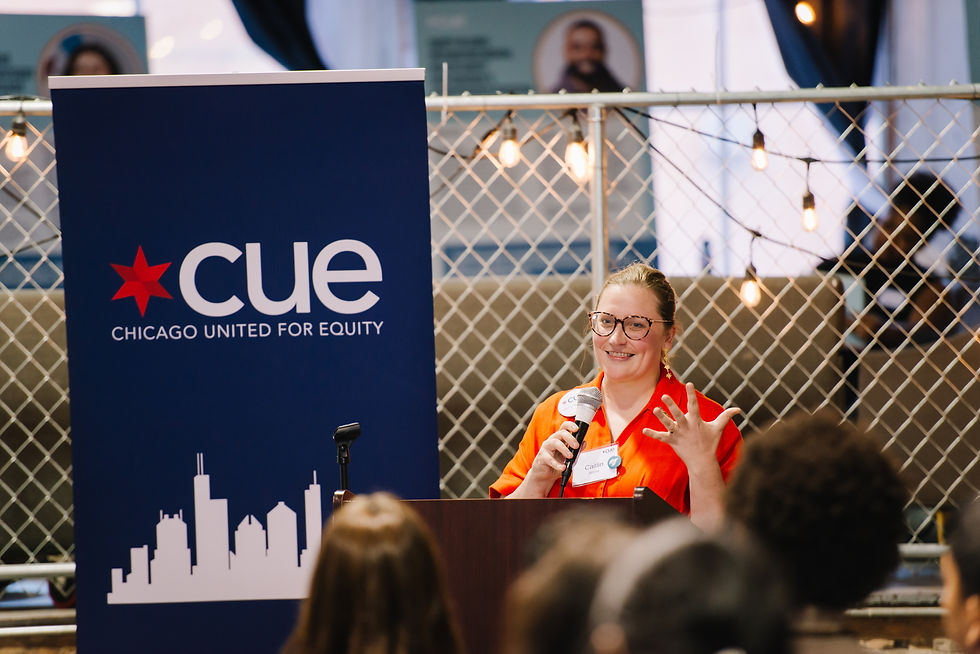
Caitlin Arens, Indigenous Curricula Project
The Indigenous Curricula Project (ICP) is a multi-year initiative that serves as a resource for educators addressing HB1633, an Illinois bill signed into law by Governor Pritzker in 2023, mandating instruction on Native American history in schools across the state. Chicago Public Schools (CPS) currently has an office supporting this work, but no place-based curricula. Pilot Light, with its 15 years of experience leading teacher professional development within CPS, has taken up the opportunity to center indigenous voices and stories to co-create a series of unit plans focused on food. The initiative looks to explore the indigenous history and culture of indigenous foodways and the four seasons across the Chicagoland area. To stay updated and learn more, email Caitlin at caitlin@pilotlightchefs.org.

Chris Cole, Equity in Care: Integrating Mental Health Equity into Chicago’s Entrepreneur Ecosystem
Equity in Care: Integrating Mental Health Equity into Chicago’s Entrepreneur Ecosystem explores the need for increased mental health support and infrastructure for BIPOC entrepreneurs not eligible for employer-based healthcare systems. Preliminary findings highlight the existing barriers to care, the need for specialized supports, and the outsized impact of the lived experiences of BIPOC entrepreneurs across Chicago. The project looks to gather information directly from entrepreneurs and together co-create recommendations that address their needs. To learn more and stay updated, visit www.teamhilo.org, follow @wearehilo_ on Instagram, or email Chris at chris@teamhilo.org.

Sam Thousand, Performance Art as an Economic Driver: Reforming the PPA License
Performance Art as an Economic Driver: Reforming the PPA License aims to expand access to the Public Place of Amusement licensing across Chicago. The South and West sides of Chicago have a growing cultural and performing arts scene, despite the fact that the majority of performing arts spaces are no longer in existence. To fill this gap, cultural curators partner with local neighborhood businesses to host community-focused events and performances. Often, these businesses are cafes and art galleries that lack the means or access to a Public Place of Amusement (PPA) license, which prevents them from hosting ticketed events and forces them to rely on suggested donations, limiting their revenue. By expanding access and reducing existing barriers to the PPA license, more neighborhood cultural hubs will be able to expand their revenue streams and deepen their community support by partnering with more local artists. Learn more by visiting www.chibrations.app.
Fireside Chat
Jerry Hawkins, CUE’s Executive Director, was joined by Shermann “Dilla” Thomas, Chicago’s Urban Historian, in a conversation to help ground us in history, connect to present-day inequity, point toward today and future action, highlight historical connections related to racial equity, and share their thoughts on hope for the future given Chicago's history.

We closed the evening with a fervent request from Terri Johnson, CUE's Board Co-Chair, to deepen community ties and invest in CUE’s work. She invited us to be inspired by our ancestors and remain hopeful no matter what the future holds, reminding us that our well-being is contingent on the collective.

Below are a few images from our event. Find the full album here.
All photos by Elia L. Alamillo - E.L.A. Photography
Resources:


